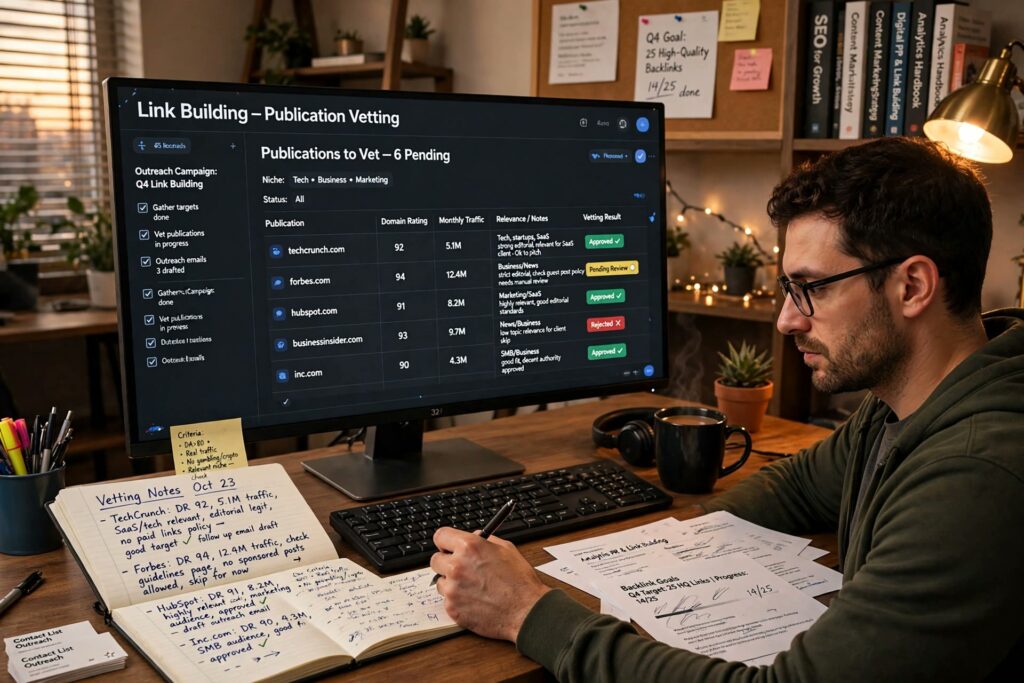
Manual link building means a person does every step that decides whether a link is worth having: finding the publication, checking it by hand, writing to its editor as an individual, creating content for its readers, and verifying the placement once it is live. No blasting software, no private blog networks, no link packages built by script. It is slower than automated link building – and it is why the links survive updates that wipe out the automated kind.
That is how Linkuild works. Across 5,235+ orders delivered, our placements are still live at a 98% rate, because each one was placed by someone who had checked the site, read its content and spoken to its editor first. This page explains exactly what “manual” means in our process, what we never automate, and the quality controls every placement passes before it reaches your report.
| Orders delivered | Placements still live | Every placement reported with |
|---|---|---|
| 5,235+ | 98% | Live URL, anchor text and link type |
What “manual” actually means
The word gets abused. Some vendors call a service manual because a human presses send on a mail-merge to 5,000 scraped addresses. That is automation with a witness. In our work, manual describes where the judgement sits:
- Prospects are chosen one at a time. A researcher opens the publication, reads it, and decides whether it belongs on your shortlist. Lists are built for your niche, not pulled from a shared database of whoever answered last month.
- Outreach is written to a person. Each pitch references the publication’s actual content and audience. Editors reply to people; they delete templates.
- Content is created for the publication. The article is written to the editor’s standards and the readers’ expectations, with your link placed where it genuinely helps the reader.
- Every placement is checked by eye. A person opens the live article, confirms the link, its anchor and its attribute, and rechecks it 30 days later.
Software still has a place – research tools surface data and our own backlink placement checker verifies live links. But no tool decides which sites are good enough for your brand, and no tool talks to editors on your behalf. Those decisions are the service.
The manual process, step by step
1. Targets before tactics
We start from the pages you want to rank and the searches behind them. That decides which publications matter: the ones your customers read and your competitors earn links from. A link plan built on target pages looks very different from a package of “50 links, mixed niches” – and it is the difference between links that support rankings and links that just fill a report.
2. Prospect research, by hand
Researchers find candidate publications in your niche: trade titles, established blogs, news and magazine sites, and resource pages. Each candidate is opened and read – recent articles, real authors, an actual audience. Sites that exist to sell links to anyone are visible within minutes of reading, and they are cut here, before any vetting numbers are even checked.
3. Vetting against a scorecard
Surviving candidates are scored on the same criteria we publish in our link acquisition guide:
| Check | What we look for |
|---|---|
| Relevance | The publication covers your industry or an audience adjacent to it |
| Real traffic | Organic visitors and engagement, not just an authority score |
| Editorial standards | Named authors, edited content, a rejection rate – signs a human gatekeeps |
| Outbound profile | Who else the site links to; spam neighbours disqualify a site |
| History | Consistent publishing and ownership, no sudden niche pivots or expired-domain relaunches |
You approve the shortlist before outreach begins. Nothing is pitched in your name that you have not seen.
4. Personalised outreach
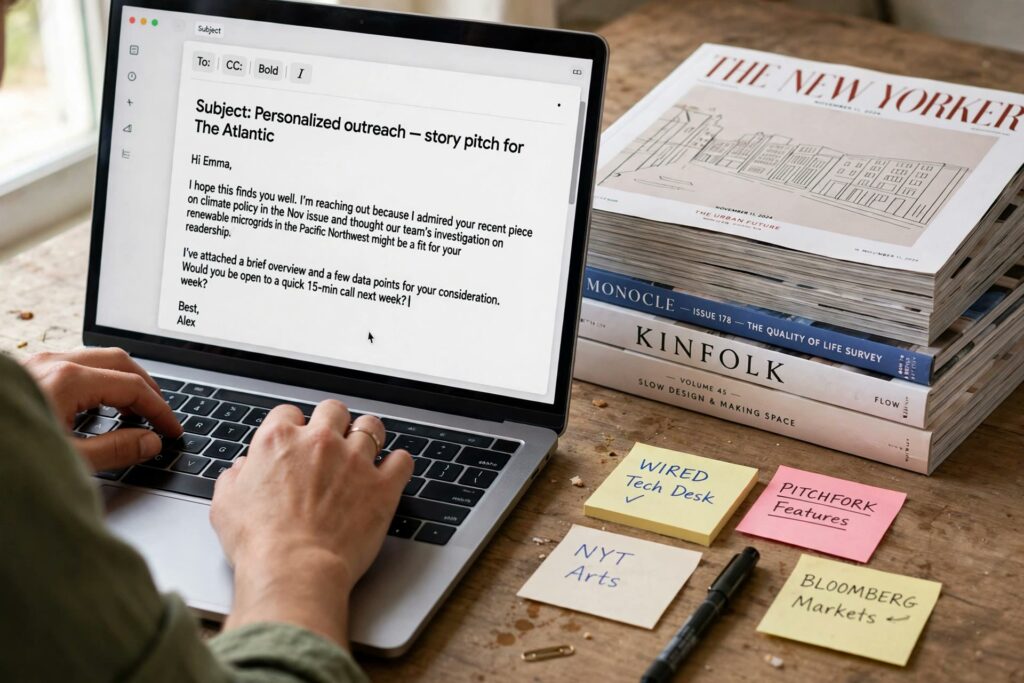
Each editor gets an individual approach: a subject relevant to their readers, an angle that fits their publication, and a reason your content improves their page. Follow-ups are written, not scheduled blasts. This is the step automation performs worst – editors can tell – and the step that decides whether top publications say yes at all. Our blogger outreach and guest posting services run on the same principle.
A manual pitch has a recognisable shape. It names something specific the publication ran recently and why its readers responded to it. It offers one angle, described in a sentence or two, that fits the publication’s beat – not a menu of ten topics copied to everyone. It shows a relevant example of published work. And it makes saying no easy, which paradoxically is what makes editors answer at all: a pitch that respects the reader’s time gets read. What it never contains: flattery templates with the site name swapped in, claims of being a “long-time reader” from someone who arrived yesterday, or pressure about deadlines the editor never agreed to. Follow-ups, when they come, add something – a new data point, a shorter version of the offer – rather than repeating “just bumping this up” until the address is burned. This is slow, unglamorous work. It is also the entire difference between outreach that opens top publications and outreach that fills spam folders.
5. Content created for the publication
When an editor agrees, the article is written for their readers first: their format, their depth, their voice. Your link sits inside genuinely useful content, with anchor text that fits the sentence. Content written to carry a link reads like it, and editors – and Google – discount it accordingly.
6. Placement review
On publication, a person opens the article and checks: the link is present in the body, the anchor is as agreed, the attribute (followed, sponsored or nofollow) matches what was ordered, and the page can be indexed. Anything that fails is raised with the editor immediately, while the relationship is warm.
7. Reporting and the 30-day recheck
Your report lists each placement’s publication, live URL, target page, anchor text, link type and date. Thirty days later we recheck every link. Removals and quiet attribute changes mostly happen in that first month, and a placement rechecked is a placement we can stand behind – the same standard we recommend in our link audit work.
Inside the vetting: what disqualifies a publication
The scorecard is only half the story. More publications fail our checks than pass them, and the failures follow patterns worth knowing – because a vendor who will not show you their rejection reasons is probably not rejecting anything:
- A “write for us” page that accepts everything. Publications that publish any submission for a fee have no editorial bar, and Google knows it. If acceptance is guaranteed before the content is read, the link is worth little.
- Outbound links to spam niches. A site linking happily to casino, loan or adult sites tells you what neighbourhood your link would live in. One look at a few recent articles settles it.
- Traffic that does not match the claims. Big authority scores with near-zero organic visitors usually mean the score was inherited, bought or built on an expired domain.
- No real authors or audience. Anonymous content, no engagement, no social presence, no readership signals – a publication nobody reads cannot pass value or send visitors.
- A sudden change of topic or ownership. A local news site that abruptly starts publishing marketing listicles has usually been sold. Its archive is real; its present is a link shop.
- Links sold in the open. Price lists for dofollow links published on the site itself are as clear a link-scheme signal as exists.
How long a manual campaign takes
Manual work runs on editorial time, and an honest timeline looks like this:
| Stage | Typical timing |
|---|---|
| Research and vetting | Days 1-5 – prospects found, scored, shortlist sent for your approval |
| Outreach | Weeks 1-2 – individual pitches and follow-ups; good editors reply in days, not minutes |
| Content and editorial review | Weeks 2-4 – drafting, editor feedback, revisions |
| Publication | Weeks 2-6 – on the publication’s schedule, staggered naturally |
| Recheck | Day 30 after each placement goes live |
Anyone promising dozens of quality placements inside a week is describing a network, not outreach. Real campaigns compound instead: the relationships built in month one make month three faster, because editors who have published you once answer the second pitch.
How to judge a manual campaign’s results
Count links last. First check whether the right pages are gaining visibility for the right searches in Search Console.
Then look at referral traffic from the new placements, growth in branded searches and how many links are still live after three to six months. A good campaign shows steady progress on all of these, not a sudden spike.
A worked example: planning a first month
Here is how we would plan a first month for a typical B2B software site. It is an illustration of the process, not a client result.
- Pick the pages. Two product pages and one in-depth guide that already rank on page two.
- Check them first. Fix titles, internal links and thin sections using an on-page SEO checklist, so links land on pages ready to rank.
- Shortlist publications. Software, marketing and business titles whose readers match the buyer, scored for topic fit and real traffic.
- Mix link types. Mostly editorial guest articles, plus one or two relevant insertions into articles that already rank.
- Vary anchors. Brand name, page titles and natural phrases, with very few exact-match keywords.
- Review after 90 days. Search Console positions and clicks for the three target pages, not just the link count.
What we never automate
- No automated outreach. No scraped-email blasts, no mail-merge campaigns, no AI-generated pitches sent at volume.
- No private blog networks. No PBNs, no expired-domain networks, no sites built to sell links.
- No mass tactics. No comment spam, forum profiles, directory dumps or automated submissions.
- No spun or templated content. Every article is written for the publication it appears on.
- No link schemes. The tactics Google lists in its spam policies – buying ranking-passing links at scale, excessive exchanges, automated creation – are exactly what manual work exists to avoid.
None of this is purity for its own sake. Automated links are the first discounted in every spam update, and they put the client’s site – not the vendor’s – at risk. Manual work is slower because the safety is the work.
Types of links we build manually
Manual does not mean one tactic. We choose the link type that suits the page and the publication, and most campaigns mix several.
- Editorial guest articles. Original articles on relevant publications, with a link where it genuinely helps the reader. Our guide to guest posting in 2026 covers what editors accept.
- Link insertions. A relevant link added to an existing article that already ranks, often called a niche edit. These need extra care, because the page must stay useful after the edit.
- Digital PR. Data, stories or expert comment pitched to journalists. These earn some of the strongest editorial links, as our digital PR services page explains.
- Mention reclamation. Turning existing unlinked brand mentions into links, one of the safest wins available.
- Resource and broken link outreach. Suggesting your page where it fills a gap or replaces a dead link.
Manual vs automated vs network links
| Manual link building | Automated / network links | |
|---|---|---|
| How sites are found | Researched and read by a person, per campaign | Scraped lists and shared databases |
| Outreach | Individual, written to each editor | Mail-merge blasts or none – the network is owned |
| Content | Written for the publication | Templated, spun or AI-generated at volume |
| Quality control | Every placement opened, checked and rechecked | A spreadsheet of URLs |
| Survival | Placements built to stay live (98% across our orders) | First discounted in spam updates; removals common |
| Risk to your site | Low – links follow Google’s guidance on qualifying outbound links | Real – link schemes can draw manual action |
Quality controls on every order
- Client-approved shortlist. You see and approve every publication before outreach.
- Editorial gatekeeping. We target publications that can say no – that is what makes their yes valuable.
- Anchor review. Anchors are varied and natural across the campaign; the same commercial keyword is never repeated at scale.
- Live verification. Each placement is opened and checked – link, anchor, attribute, indexability – using the same checks as our free checker.
- 30-day recheck. Every link revisited a month after publication; changes are reported and raised with the publisher.
- Full reporting. Live URLs, not screenshots of promises. If a placement cannot be verified, it does not go in your report as delivered.
How manual links hold up through Google updates
Google has run several spam updates in 2026 alone. Links from relevant, editorially reviewed pages are the kind those updates are designed to leave alone.
What gets hit are patterns: networks of sites built to sell links, irrelevant placements and heavy exact-match anchors. Our breakdown of the September 2026 spam update explains what Google targeted.
Who manual link building is for
Manual work suits businesses where the cost of bad links is real: SaaS and B2B companies building long-term rankings; ecommerce brands in competitive categories; local and national service businesses whose names sit on the publications themselves; and agencies, who resell our manual process under their own brand through white-label link building. If you need the cheapest possible links by Friday, this is not that service – and the pages selling it are not your friends either.
Red flags when choosing a manual link building provider
The same warning signs show up in weak proposals again and again. If a provider shows two or more of these, keep looking.
- Guaranteed rankings or guaranteed placements on named top-tier titles.
- A fixed number of links promised before anyone has looked at your site.
- No chance to approve sites before placement.
- Every link using the same exact-match anchor.
- Reports with totals but no live URLs.
- Prices that only make sense with automation or link networks.
Our seven questions to ask a link building agency turn these into an interview checklist, and our guide on how to vet a link building agency before you pay covers what to check on the sites themselves.
What manual link building services cost
Manual work is priced by the human hours and the publications involved, so honest quotes come once we know your goals. Email us and we will send the publication list for your niche with exact per-publication prices. The market ranges look like this:
| Placement type | Typical market range |
|---|---|
| Editorial guest placement on a vetted niche publication | $100 – $500+ |
| Top-tier or national publication | $1,000+ |
| Digital PR campaign (story, data, journalist outreach) | Quoted per campaign |
Prices move with the publication’s traffic, editorial bar and niche. Beware the opposite end of the market: packages offering dozens of “manual” links for the price of one real placement are not manual in any sense that matters – the hours simply are not in the price. Our broader link building services page explains how pricing works across every service.
What moves the price
- Publication quality. A national business title costs far more than a small niche blog.
- Niche difficulty. Finance, health and legal sites are pricier and stricter.
- Content effort. A researched long-form article costs more than a short insertion.
- Link type. Digital PR involves more work per link than guest articles.
- Strategy and reporting. Retainers that include planning and analysis cost more than placement-only orders.
What you receive
- An approved publication shortlist before any outreach
- Individual outreach to each editor, handled end to end
- Editorial content written for each publication
- A report with live URL, anchor, link type and date for every placement
- A 30-day recheck of every link, with changes flagged
What every report shows
You should be able to check every link yourself in a few minutes. This is the format we send:
| What it shows | Why it matters |
|---|---|
| Publication and live article URL | You can open the placement yourself |
| Target page | Shows which of your pages the link supports |
| Anchor text | The exact words linked, so you can keep anchors natural |
| Link attribute | Followed, nofollow or sponsored, as published |
| Date live | When the article went up |
| Status check | Whether the link was still live at the last check |
If a provider cannot give you this level of detail, you cannot verify what you paid for.
Frequently asked questions
What is manual link building?
Link building where the judgement calls are made by people: prospects researched and read individually, outreach written to each editor, content created for each publication, and every placement checked by eye. Tools support the research and verification; they do not make the decisions or send the emails.
Is manual link building safe?
It is the safest form of link building there is, because it follows the logic of Google’s own guidance: earn links inside genuinely useful content on publications with real editorial standards, and label paid placements correctly. No method can promise immunity from algorithm changes, but manual placements are not the pattern spam updates target.
How many links can you build per month?
It depends on your niche and the publications’ editorial calendars. A realistic manual campaign delivers a steady flow of placements rather than a fixed bulk count – editors publish on their schedules, not ours. We agree a target range with you before work starts and report against it weekly.
How is this different from your regular link building services?
Our standard services are already manual – this page exists because buyers who have been burned by “manual” packages want the process in writing. The difference is emphasis: here the vetting, outreach and verification steps are the product, documented end to end, rather than a means to a link count.
How do you report progress during a campaign?
You see the campaign as it happens, not just at the end: the approved shortlist before outreach, confirmations as editors accept, and a live report that fills in with each placement’s URL, anchor, link type and date as it publishes. If an editor declines or a placement stalls, that is reported too, with the replacement we propose. At day 30 after each placement you get the recheck result, so the report you hold at the end of a campaign is one we have already verified twice.
Can I do manual link building myself?
Yes – nothing in this process requires an agency. It requires time: researching and vetting a single publication properly takes the better part of an hour, outreach and follow-ups run for days, and writing an article an editor accepts takes hours more. Teams usually hire us when that time costs more than our fee, or when they want access to publications and editor relationships built over years of campaigns. If you do it yourself, the scorecard and checks on this page are the ones to follow.
Do you guarantee rankings?
No, and no honest provider can. Rankings depend on your content, your market and your competitors as well as your links. What we guarantee is the work itself: approved publications, editorial placements, verified live links and a 30-day recheck on every one.
Start with links a person actually built
Tell us the pages you want to rank and the market you are in. We will research a shortlist of publications we would pitch by hand, show you the exact prices in the catalogue, and let you judge the process before you commit. Start with a free SEO audit or contact us for the publication list.
By Adnan Aslam, founder of Linkuild. He has run manual outreach campaigns for over three years – the process on this page is the one his team follows on every order.