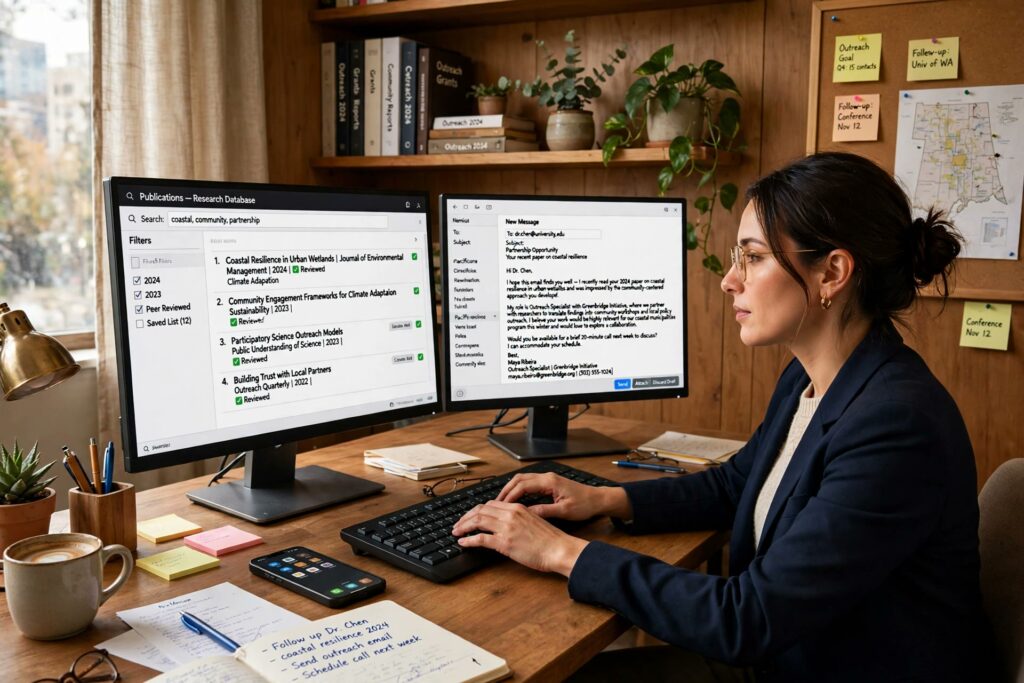
SEO outreach is the work of earning links by contacting the people who control them: editors, journalists, bloggers and resource-page owners. An SEO outreach service researches the publications your buyers actually read, builds something worth linking to, pitches it personally, and follows through until the link is live – then verifies it. No catalogue, no checkout. The placements are earned one conversation at a time, which is why they are the links competitors cannot simply buy after you.
That is the service on this page. Linkuild has delivered 5,235+ orders with 98% of placements still live, and outreach is the engine behind the strongest of them. Below: what SEO outreach actually involves, how it differs from guest posting and blogger outreach, the process we run, and what it costs.
| Orders delivered | Placements still live | Every placement reported with |
|---|---|---|
| 5,235+ | 98% | Live URL, anchor text and link type |
What SEO outreach is – and what it is not
Outreach is a discipline, not a deliverable. The deliverables – links on relevant publications – come at the end of a chain: find the right people, give them a genuine reason to link, and make it easy to say yes. Three things get confused with it:
| SEO outreach | Buying placements | |
|---|---|---|
| How the link happens | An editor decides your content or story deserves the link | You pay a listed price and the link appears |
| What you need first | Something link-worthy: data, expertise, a tool, a story | A budget and an article |
| Which publications | Any that fit – including ones that sell nothing | Only sites in a catalogue or network |
| Failure mode | Editors say no – so the pitch and asset must be good | The link is live but worthless, or removed later |
| Compounding effect | Editor relationships carry into the next campaign | None – every order starts from zero |
Our guest posting services and blogger outreach use outreach too – the difference is scope. Guest posting pitches articles to publications that accept them; blogger outreach works the independent-blog tier specifically. SEO outreach is the broader campaign discipline: any publication, any format – data stories, expert commentary, resource inclusion, digital PR – chosen because it fits the ranking goal. Our digital PR services sit at the news end of the same spectrum.
What we pitch: the link-worthy asset
Editors do not link to homepages out of kindness. Every outreach campaign starts from an asset – something a publication gains by referencing:
- Original data and research. Surveys, industry studies, pricing analyses, trend reports. Data is the most consistently linkable asset there is, because journalists need numbers they cannot invent.
- Expert commentary. Your founder’s or specialists’ informed reaction to industry news, offered to journalists on deadline. Fast to produce, and it builds the brand as well as the link profile.
- Free tools and calculators. Genuinely useful utilities that resource pages and articles reference for years.
- Definitive guides and research content. The page in your niche that simply answers the question best – pitched to everyone currently linking to weaker versions.
- Stories with a human angle. Customer outcomes, unusual company data, local angles – the raw material of coverage rather than content marketing.
If you already have an asset, we audit it before pitching – an honest assessment, because pitching a weak asset burns editor relationships we both need later. If you do not, creating one is part of the engagement, scoped before outreach begins.
The audit asks four questions. Is the underlying material sound – data a journalist could defend, claims that survive a sceptical read? Is the page itself ready to receive links: clear, fast, with methodology and sources visible rather than buried? Is there a quotable core – the one finding or sentence a writer can lift without rewriting your whole argument? And does it serve a reader who is not you – the test most company content fails, because it was written as a brochure. Assets that pass all four get pitched hard. Assets that fail get fixed first, and we will tell you that plainly rather than spending your budget proving it.
The outreach process
1. Goals and target pages
We agree which pages need links and which searches sit behind them. Outreach without target pages produces links that look good in a report and do nothing in rankings; the target list disciplines every later choice, from which publications matter to which anchors make sense.
2. Prospect research
We build the prospect list from your market outward: publications your customers read, sites linking to your competitors, journalists covering your beat, resource pages in your niche. Each prospect is checked against the vetting standards in our link acquisition guide – relevance, real traffic, editorial standards, outbound profile. You approve the list before anyone is contacted in your name.
3. Pitch crafting
Each pitch is written for one recipient: their publication, their recent coverage, the specific asset and why their readers gain from it. Subject lines are plain and honest. The pitch is short – editors decide in seconds, and a pitch that respects that gets read. (The anatomy of a pitch that earns replies is covered on our manual link building page; outreach is where that craft is applied at campaign scale.)
4. Follow-up and negotiation
Most placements come from follow-ups, not first emails – a short, useful nudge with something added, never a repeated “just checking in”. When an editor is interested, we handle the practical negotiation: format, timing, link placement, attribution. Where a publication’s model is paid placement rather than earned coverage, we tell you plainly and let you decide – the two are never quietly mixed.
5. Placement, verification, reporting
When coverage lands, we verify the live article – link present, anchor as agreed, attribute correct, page indexable – and report it with its URL. A 30-day recheck follows, because early removals and quiet changes are exactly what unmonitored campaigns never notice. Anything that fails verification is chased or replaced, not buried.

The outreach lanes we work
“Outreach” covers several distinct crafts. A serious campaign usually runs two or three of these lanes at once, chosen by what your asset and market support:
- Editor and journalist pitching. Direct approaches to the people who commission and write coverage in your niche – the core lane, and the slowest to build but the strongest in results.
- Journalist request services. Platforms where journalists post what they are working on and ask for expert sources. Speed and relevance win here: a sharp, quotable response inside the deadline earns coverage (and a link) that cold pitching rarely reaches. This is commentary outreach, run as a standing programme rather than a one-off.
- Resource-page and curation outreach. The maintained lists, tool roundups and reading pages every niche has. Getting included means fitting the page’s existing standard and making the curator’s job easy – a short, specific, honest approach.
- Broken-link and replacement outreach. Finding references on relevant pages that now point to dead or moved content, and offering your working resource as the replacement. It works because it starts by helping the publisher fix something.
- Relationship follow-through. Past contributors, previous coverage, unlinked brand mentions. The warmest prospects in any campaign are the people who already know the brand – our audit looks for them first, including mentions that were never linked, using the same approach as our link audit work.
Each lane has its own etiquette, and editors feel the difference between a practitioner and a blast tool within one sentence. The lanes share one rule across all of them: the approach is written for the person receiving it, or it is not sent.
What makes outreach succeed or fail
After thousands of campaigns, the pattern is not complicated:
- The asset decides most of it. A genuinely useful study gets links from a mediocre pitch; a brilliant pitch cannot save a page with nothing to offer. Campaigns that start with “we need links” instead of “we have something worth linking to” fail politely and completely.
- Relevance beats authority scores. A mid-sized trade publication your buyers read will outperform a famous site in an unrelated field – in referral value, in ranking relevance, and in how natural the link looks to Google.
- Personalisation is the price of replies. Editors can identify a mail-merge in one line. Our outreach is written by people, to people, which is why our white-label partners resell the same process under their own brand.
- Volume is a vanity metric. Fifty careful pitches to the right editors outperform five hundred blasts – and protect your domain’s name, which blasts spend freely.
- Honesty about labelling. Earned editorial links are earned. Anything paid is labelled as Google’s spam policies require. Campaigns built on disguised paid links carry a risk no ranking gain justifies.
Who SEO outreach is for
Outreach earns its fee where the link cannot simply be bought: SaaS and B2B brands whose buyers trust specific trade publications; companies launching data or research they want covered; businesses in niches where the top publications accept pitches, not orders; and agencies that need outreach capacity without hiring. It is the wrong tool for one job – filling a link quota by Friday. That job exists, it is called buying placements, and we would rather name it than disguise outreach as it.
What SEO outreach costs
Outreach is priced on the work – research, asset preparation, pitching hours and campaign management – rather than per link, because earned placements cannot be inventoried in advance. For orientation, the market around it looks like this:
| Placement outcome | Typical market range |
|---|---|
| Editorial placement on a vetted niche publication | $100 – $500+ per placement equivalent |
| Top-tier or national publication coverage | $1,000+ per placement equivalent |
| Full outreach campaign (research, asset, pitching, reporting) | Quoted per campaign after a short scoping call |
Exact pricing for your campaign comes after a short scoping conversation, when we can see your market, your assets and the publication list – anyone quoting a fixed per-link price for “outreach” before that conversation is selling catalogue placements under an outreach label. Our link building services page explains how pricing works across all services.
What you receive
- An audit of your linkable assets, with honest gaps named
- An approved prospect list of publications and contacts before outreach starts
- Personalised pitches written and sent in your brand’s name
- Follow-up and negotiation handled end to end
- A live report: publication, URL, anchor, link type and date for every placement, with a 30-day recheck
Frequently asked questions
How is SEO outreach different from guest posting?
Guest posting is one outreach format: pitching finished articles to publications that accept them. SEO outreach is the wider discipline – data stories, expert commentary, resource-page inclusion, digital PR – aimed at any publication that fits the goal, including those that would never take a guest article. Most campaigns use guest posting as one lane among several.
Do you guarantee a number of links?
No – earned coverage cannot be guaranteed without quietly turning it into buying, and we will not do that under an outreach label. What we commit to is the work itself: an agreed prospect list, an agreed volume of personalised outreach, transparent reporting of replies and outcomes, and verified live links for everything that lands.
What do you need from us to start?
Access to your site and goals, one person who can approve prospect lists and assets quickly, and – ideally – something link-worthy. If the asset does not exist yet, we scope creating it (a study, a tool, an expert-commentary programme) as the first phase. Campaigns stall on slow approvals more than on editor replies, so a responsive contact on your side genuinely changes results.
How long before outreach produces links?
First placements typically land within three to six weeks: research and approvals in week one, pitching from week two, and editorial calendars deciding the rest. Commentary-led outreach can land in days when news breaks; data campaigns take longer to prepare and then earn for months. Anyone promising earned links inside a week is not describing outreach.
Can agencies white-label your outreach?
Yes. The full process – research, pitching, reporting – runs under your brand through our white-label programme, with reports formatted for your clients. Your clients see your agency doing outreach; we do the outreach.
Do you run outreach for local businesses?
Yes, with a local shape: regional publications, local business press, community resources, chambers and niche directories that carry real editorial weight, plus commentary in local media. Local outreach succeeds on relevance more than scale – a link from the paper your customers actually read is worth a portfolio of unrelated national blogs.
Is outreach safe under Google’s rules?
Outreach itself is simply communication – it is how the web has always worked. The compliance questions sit with the link: earned editorial links are the model Google’s guidance is built around, and any placement that turns out to be paid must be labelled accordingly. We keep that line bright, and it is one reason our placements stay live at the rate they do.
Start with a prospect list, not a promise
Tell us your market and the pages you want to rank. We will show you the publications we would pitch, the asset we would pitch with, and the exact price of the campaign – before you commit. Start with a free SEO audit or contact us to scope it.
By Adnan Aslam, founder of Linkuild. The outreach process on this page is the one his team runs for client and white-label campaigns.