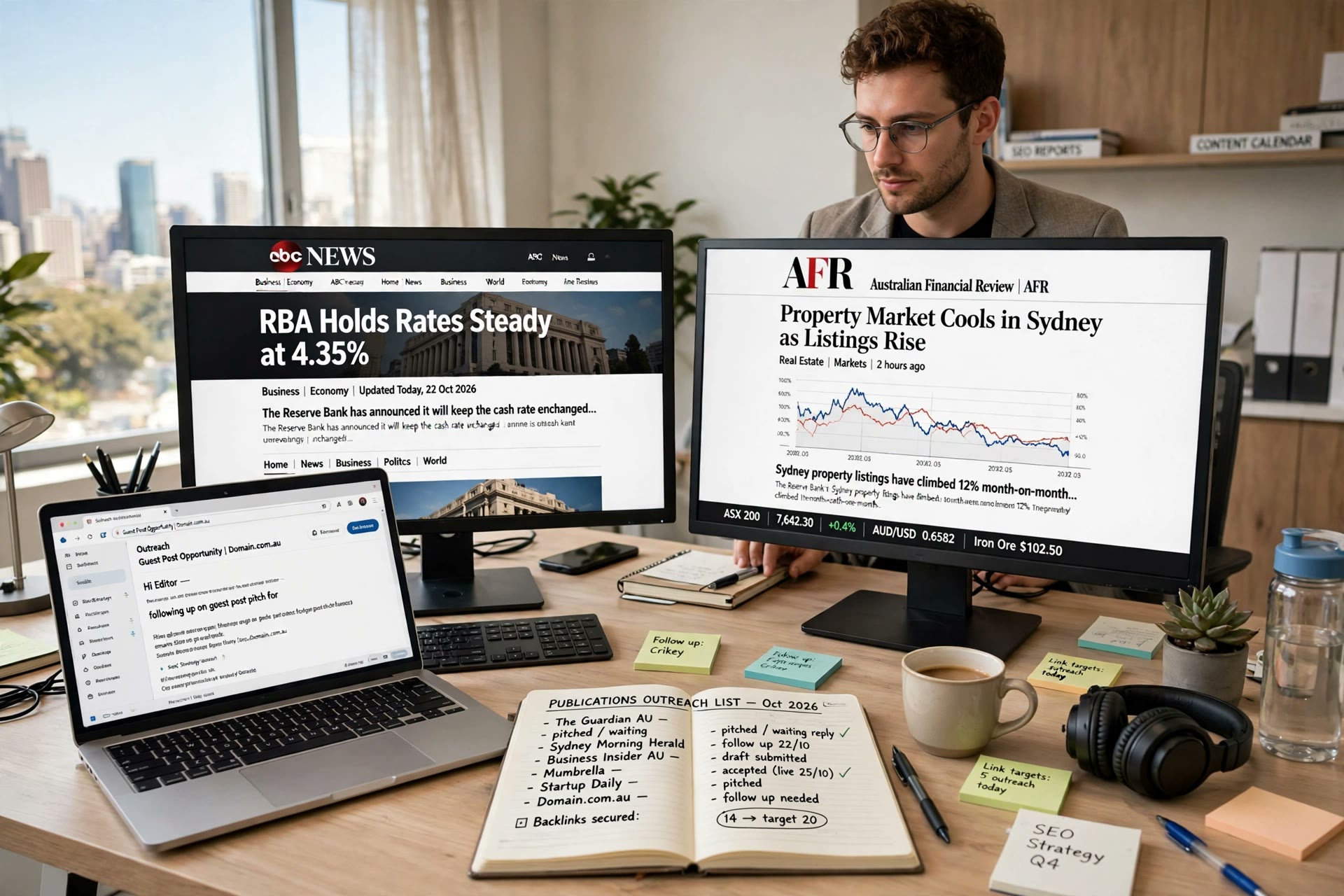
Linkuild is a UK-based link building company, and this page exists because Australian businesses keep finding us anyway. So, the honest answer first: we do not have a Sydney office, we will not pretend to, and nothing on this page is written to make you think otherwise. What we do have is a working record of placing Australian clients on Australian publications – national media, .com.au business and lifestyle titles, and the Australian editions of global publications – vetted the same way we vet every placement we sell, and reported with live URLs you can check yourself. If a local postcode matters more to you than that record, hire locally. If the placements matter most, read on.
| Proof, not promises | |
|---|---|
| Orders completed | 5,235+ |
| Placements still live | 98% |
| Reporting | Every placement delivered as a live URL you can verify |
| Link types | Dofollow by default; the attribute on every order agreed in writing before we start |
What link building services in Australia actually involve
Strip away the sales language and a link building service does three things: it finds publications your customers and Google both respect, it gives those publications a genuine reason to mention and link to you, and it proves the link exists and stays live. In the Australian market, each of those steps has local texture that generic offshore services usually miss.
The publications are a mix, not a single tier. A credible Australian link profile combines national media and its digital editions, .com.au business, finance, lifestyle and industry titles, and global publications with Australian editions or Australian audiences. A service that only offers one tier – only directories, only small blogs, only “news sites” nobody reads – is selling you its inventory, not building your profile.
Relevance is geographic as well as topical. A link from an Australian publication carries local relevance signals a random overseas blog cannot, which matters most for businesses competing in Australian search results. But geography is not magic: an irrelevant .com.au link farm is worth less than a relevant global publication your industry actually reads. Good services balance both instead of chanting “Australian links” as if the domain ending were the strategy.
The work is mostly judgement. Anyone can buy a list of websites that accept paid posts. The service you are paying for is the vetting – checking real traffic, reading what a site publishes, refusing the placements that would embarrass your brand or endanger your rankings – and the outreach that reaches publications which never join a catalogue. That is as true in Melbourne as it is in Manchester, which is why the process below looks the same as our worldwide link building services, with the publication mix pointed at Australia.
The publications we place Australian clients on
We do not publish a price list of individual websites, and you should be suspicious of services that do – it usually means the list is a marketplace catalogue anyone can buy from. What we can describe honestly is the shape of the inventory we work with for Australian campaigns:
- National and metro media (digital editions). The hardest placements and the most valuable: real editorial environments with Australian audiences in the millions. Reached through digital PR angles and contributed content, never through a checkout.
- .com.au business and finance publications. The working tier of most B2B campaigns – established Australian titles covering business, startups, finance, property and technology, with genuine local readership.
- Australian lifestyle and consumer titles. Parenting, health, home, travel and food publications where consumer brands earn coverage; the tier where our health and parenting placements most often land.
- Industry and trade publications. Smaller audiences, higher relevance: the titles your sector reads, which often drive the referral traffic that actually converts.
- Australian editions of global publications. International media brands publish Australian editions and Australian-focused stories; a placement there combines brand weight with local relevance.
Every candidate publication passes the same vetting we apply everywhere: verifiable traffic rather than a screenshot of a metric, a real editorial operation, an outbound-link neighbourhood we would put our own name next to, and labelling that complies with Google’s spam policies on paid placements. Publications that fail are refused, including ones clients specifically ask for – a refusal you will hear from us before you hear a sales pitch.
How an Australian campaign runs
- Audit first. We review your current backlink profile and your Australian competitors’ profiles. If your existing links contain the kind of damage described in our link audit service, we say so before selling you more links.
- Target list agreed with you. You see the publication types and specific targets we intend to pursue, with the link attribute for each agreed in writing. No mystery inventory appears later.
- Angles and content. For editorial placements, we develop the story or the contributed piece the publication would actually run – written for its readers, in Australian English, to its editorial standards.
- Outreach and placement. Our team pitches and manages each publication directly. This is the same discipline described on our manual link building page: no automation, no mass templates, no bought lists.
- Live-URL reporting. Every placement is reported as a live link. Check it yourself in our free backlink placement checker – link present, anchor as agreed, attribute as ordered.
- Rechecks. Placements are rechecked after delivery; if a link drops inside the agreed window, we chase the publication or replace the placement under the terms agreed at order.
Typical campaign timeline
| Stage | Timing | What you receive |
|---|---|---|
| Audit and strategy | Days 1-5 | Profile audit findings, competitor gap summary, proposed publication targets |
| Targets and content | Weeks 1-2 | Target list approved by you; angles and articles in production |
| Placements land | Weeks 2-6 | Live URLs reported as each placement publishes – not batched at month end |
| Recheck and report | Day 30, then quarterly | Placement status recheck; dropped links chased or replaced under order terms |
Editorial lead times are the variable nobody controls: a contributed article at a national title can take a month between acceptance and publication, while a mid-tier business title may run a piece in days. We report acceptances as they happen, so a quiet week is visible as editorial process rather than silence.

What link building costs in Australia
Australian link building is priced in two currencies in practice: many .com.au publications quote in AUD locally, while the international placement market – including most premium media – trades in USD. We quote in USD and say so upfront, rather than dressing a converted price up as a local one. The ranges below are the market ranges we see when buying Australian placements, not a per-site price list (our pricing methodology is explained on the main services page, and it applies here unchanged):
| Placement type | Typical market range (USD) | Notes |
|---|---|---|
| Mid-tier .com.au publication | $150 – $450 | Established niche and business titles with verifiable traffic |
| Strong .com.au business / lifestyle title | $450 – $1,000 | Recognisable brands, real editorial process, longer lead times |
| National media / Australian edition of a global title | $1,000+ | Digital PR territory: priced per campaign angle, not per link |
| Guest post on a vetted Australian blog | $100 – $350 | Only where the blog has a genuine audience – most do not qualify |
Two warnings about Australian pricing specifically. First, any service quoting suspiciously cheap “Australian links” in bulk is selling directory and PBN inventory with .com.au domains – the domain ending is cheap to register, and it is doing all the work in that pitch. Second, the same publication often appears in international catalogues at marked-up prices; cross-checking is the easiest saving in this market, a pattern we documented in our guest post marketplace guide.
What a healthy Australian link profile looks like
Buyers often ask how many links they need. The honest answer is that profile shape matters more than profile size, and Australian profiles have a recognisable healthy shape:
- A believable tier mix. A few hard-won media placements, a working layer of business and industry titles, and a natural tail of smaller relevant sites. A profile that is all one tier – especially all small blogs bought in one month – reads as manufactured, because it is.
- Natural anchors. Mostly your brand name, your URL and natural phrases (“this Sydney accountant’s guide” style references where relevant), with a minority of descriptive keyword anchors. A profile where every anchor is a money keyword is the clearest footprint paid-link schemes leave.
- Steady velocity. Links arriving month by month as content and coverage accumulate – not 200 in a fortnight followed by silence. Australian niches are small enough that spikes are conspicuous.
- Relevance you can explain. For every link, a one-sentence answer to “why would this publication mention us?” If the honest answer is “because we paid”, the labelling had better be correct and the publication had better be real.
- Links that send visitors. The quiet test: a healthy profile produces referral traffic in your analytics. Links nobody ever clicks are not automatically worthless, but a profile with zero referral visits across hundreds of links is telling you something.
This is also the standard our audits measure against. When an Australian business comes to us after a cheap package, the cleanup pattern is almost always the same three faults from the list above: one-tier inventory, keyword-stuffed anchors, and a velocity spike. All three are visible in your own analytics and any backlink tool within ten minutes – check before you renew anything.
Red flags in the Australian link building market
Because Australian search volumes are smaller than US or UK volumes, this market attracts a particular kind of shortcut. Watch for these:
- City-page spam. Agencies selling “link building Sydney”, “link building Melbourne” and a dozen identical city pages are signalling scaled, templated operations – the same approach Google’s scaled-content rules target. One honest services page beats twenty geo copies, which is why this is the only Australian page we will ever publish.
- “Australian PBN” offers. Networks of .com.au domains built to sell links, often with Australian place names in the domain. The links are cheap because the sites exist for no other purpose; our link acquisition guide explains how to recognise the pattern.
- Guaranteed rankings. No link building company can guarantee a ranking position; Google says so itself, and any service promising “#1 in 30 days” is telling you what it thinks of your ability to check.
- Packages counted in links, not publications. “100 Australian backlinks for $299” is a directory submission wearing a flag. Real placements are countable on one report, with one live URL each.
- No live-URL reporting. If a service reports “links built” without URLs you can open, it is reporting an intention, not a result.
- Fake local presence. A rented virtual-office address and an (02) number that forwards overseas. Ask where the team actually sits; an honest offshore provider – like us – will simply tell you.
Choosing a link building company for Australia: an honest comparison
| Local Australian agency | Specialist provider (Linkuild) | Freelancer / marketplace | |
|---|---|---|---|
| Local knowledge | Strongest – lives in the market | Publication-level knowledge; no local office | Varies wildly |
| Placement inventory | Strong AU media relationships | AU publications plus global titles and editions | Whatever is in a public catalogue |
| Typical cost | Highest – AU overheads priced in | Mid – no local office costs in your invoice | Lowest headline price, highest failure rate |
| Vetting done by | The agency | The agency | You |
| Reporting | Usually live URLs | Live URLs, rechecked after delivery | Often a spreadsheet of promises |
| Best for | Brands wanting local PR and face-to-face | Businesses buying placements and outcomes, not postcode | Expert buyers with time to vet everything themselves |
When is the local agency genuinely the better choice? If your campaign needs Australian broadcast or print PR, local event presence, or a team in your office weekly, hire locally and pay the premium – it buys things we do not sell. When the requirement is placements on Australian and global publications, vetted properly and reported honestly, geography is overhead. Our clients in Australia buy the second thing, and the time-zone gap turns out to be practical rather than painful: briefs sent at your close of business are worked on overnight and answered by your morning.
Who this service fits
Australian campaigns we typically run: ecommerce and consumer brands placing product stories in lifestyle and parenting media; B2B and SaaS companies building authority in Australian business and technology titles; health and wellness brands (the niche where our publication relationships are deepest); and agencies buying white-label link building for their own Australian clients under their own brand. If your business sells only within one Australian city and lives or dies by a map listing, local SEO matters more than this service – we will tell you that on the first call rather than after the first invoice.
Industries we build Australian links for
Ecommerce and consumer brands
Product stories, gift guides, reviews and seasonal features in Australian lifestyle, parenting and consumer titles. Consumer placements live or die on the story – a product listing earns nothing, while a genuine angle (“the Australian homes swapping X for Y”) earns coverage a media buyer cannot purchase directly. Our deepest consumer relationships sit in parenting and wellness, where our clients’ products are regularly placed.
B2B, SaaS and technology
Authority built through Australian business and technology publications: contributed analysis, data stories and expert commentary that positions founders as voices in their market. B2B link building is slower per placement and stronger per link – one respected business title usually outweighs a dozen small blogs, and Australian buyers in this tier check who is quoted, not just who ranks.
Health and wellness
Our most selective category. Health publications are vetted hardest – editorial standards, medical review processes and labelling rules all apply – and health clients are vetted too: we place brands whose claims we can stand behind. Placements land in Australian health and lifestyle titles and the health verticals of larger publications, with content written to survive an editor who actually reads it.
Finance, property and professional services
Regulated niches where the publication’s credibility is the product. Australian finance and property titles guard their outbound links carefully, which is precisely why links from them carry weight. Campaigns here lean on data and expert commentary rather than placed articles, and timelines run longer – a constraint we state at quote stage, not after payment.
Agencies (white-label)
Australian SEO and digital agencies use our placement capacity under their own brand, reporting included. If you are an agency whose clients keep asking for links your team has no time to earn, the arrangement is simple: your strategy, your client relationship, our outreach and delivery – the model detailed on our white-label link building page.
Digital PR: earning Australian media links instead of buying placements
Some of the strongest Australian links cannot be bought as placements at all – they are earned when a publication covers a story. That is the digital PR route: original data, a survey, a genuinely useful tool or a sharp expert angle, packaged for Australian journalists and pitched properly. It is slower and less predictable than buying a placement, and the links it produces are usually worth several bought ones, because they arrive with real coverage, natural anchors and referral readers attached.
Our own linkable asset is pricing research: we buy placements across hundreds of publications for clients, and the market data that produces – what placements cost, how prices move, which sectors pay premiums – is the kind of material business journalists cite. Australian campaigns with a data angle get pitched to the same business and marketing titles Australian agencies pitch, with one difference: the pitch is written by the team that will also deliver the placement work if the story route fails, so a campaign is never betting everything on one journalist’s week. If your business has data, a customer base worth surveying, or a founder with a genuinely quotable position on your industry, tell us – that raw material is worth more than any link package either of us could buy.
Frequently asked questions
Do you have an office in Australia?
No. Linkuild is based in Wolverhampton, UK, and our team works with Australian clients remotely. We would rather tell you that in the first paragraph – which we did – than rent a virtual address in Sydney. Everything an Australian client needs from us (publication targets, content, reporting, rechecks) is delivered online, and placements are on the same Australian publications a local agency would pursue.
How much do link building services cost in Australia?
At market: roughly $150-$450 (USD) for a solid mid-tier .com.au publication, $450-$1,000 for a strong business or lifestyle title, and $1,000+ for national media or Australian editions of global publications, which are usually priced as digital PR rather than per link. We quote per placement or per campaign before work starts, in USD, with the link attribute agreed in writing. If a quote you receive elsewhere is far below these ranges, ask which publications it buys – the answer is usually directories.
Do my links need to be on .com.au domains?
Not exclusively. Australian publications carry local relevance that helps in Australian search results, and most of an Australian campaign’s placements should be Australian. But a relevant global publication your industry reads can be worth more than an irrelevant .com.au site, and Australian editions of global titles give you both. What matters is the mix, the relevance and the audience – not the domain ending alone.
How long before link building shows results in Australia?
Placements themselves typically land within 2-6 weeks of a campaign starting, depending on editorial lead times. Ranking movement follows over the following weeks and months as Google recrawls and re-evaluates; Australian keywords are often less competitive than their US equivalents, which can shorten that timeline, but anyone promising a fixed date is guessing at your expense. We report placements the day they go live, so you can separate delivery (our job, dated and checkable) from ranking movement (Google’s timetable).
Do you guarantee rankings or specific metrics?
No – and neither can anyone else, honestly. We guarantee the things under our control: the publications agreed, the link attribute agreed, live-URL reporting, and rechecks with replacement under the terms set at order. Domain authority scores are third-party estimates, not Google metrics; a service guaranteeing a DA score is guaranteeing someone else’s number.
Can you place links on publications I choose?
Often, yes – if the publication passes vetting. Send us your target list and we will tell you which titles we can reach, through which route (outreach, contributed content or an existing relationship), and at what price. If a title on your list fails our checks – fake traffic, a paid-link neighbourhood, a history of removing placements – we will show you why and suggest the nearest equivalent that passes.
Can you work alongside our existing SEO agency or in-house team?
Yes – it is one of the most common arrangements. Your agency or in-house team keeps strategy and on-site work; we supply the placement capacity and publication relationships they do not have in-house, with reporting formatted for their dashboards. Where an agency prefers to present our work under its own brand, that is exactly what our white-label service exists for.
Start with the evidence, not the pitch
If you are comparing link building services for Australia, compare what each provider will put in writing before you pay: the publication types, the link attributes, the reporting format and the replacement terms. We are happy to be compared on exactly those terms. Start with a free SEO audit of your current profile, or contact us for the Australian publication list relevant to your niche – with prices, before you commit to anything.
By Adnan Aslam, founder of Linkuild – a UK-based link building and digital PR agency serving clients in Australia, the UK, the US and beyond. Market ranges on this page are the ranges we observe when buying Australian placements, checked October 2026.