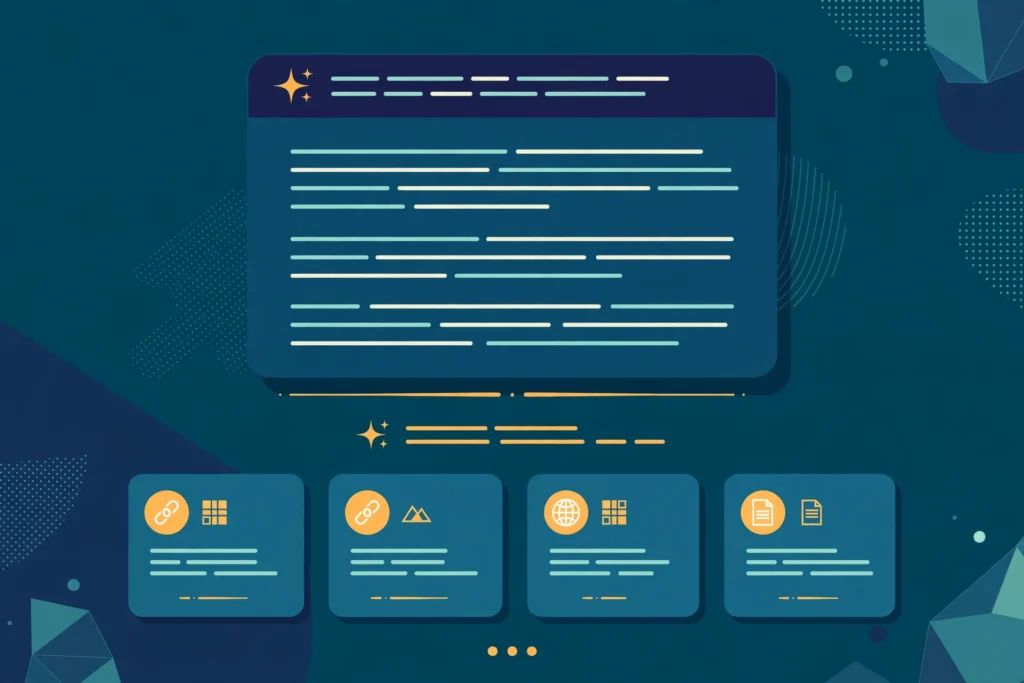
Search is no longer a list of ten blue links. When a customer asks an AI engine a question, they get one answer — and that answer names a handful of brands.
The brands that get named win the click, the comparison, and often the sale. The brands that don’t are invisible, even if they rank on page one of Google.
That shift is why three terms now dominate search marketing: GEO (generative engine optimization), AEO (answer engine optimization), and AI visibility. They overlap, they get confused with each other, and vendors sell them as if they were magic.
This article separates what is actually known from what is hype, using published research from 2024 to 2026 — and it answers the question every brand really asks: if AI mentions you early, will it recommend you when it matters?
Search has changed: from links to answers
The numbers behind the shift are stark. Pew Research found in March 2025 that users clicked through only 8% of the time when a Google result page showed an AI summary, compared with 15% when it did not.
Semrush reported in September 2025 that AI Mode produces a zero-click result roughly 93% of the time. And yet AI-referred traffic is exploding: eMarketer measured AI-referred sessions up 527% year over year in the first half of 2025. Gartner projected back in 2024 that traditional search volume would fall 25% by 2026.
Read together, those figures tell one story. Fewer people click, but the clicks that remain — and the recommendations inside AI answers — carry more weight than ever. Being the cited source inside the answer is becoming as valuable as ranking first used to be. That is the whole game of AI visibility.
GEO, AEO, and AI visibility: what each term actually means
Generative engine optimization (GEO) means optimizing your content so generative AI engines — ChatGPT, Perplexity, Google’s AI Overviews and AI Mode, Claude — retrieve it, cite it, and use it when composing answers.
The term comes from a 2024 research paper by Aggarwal and colleagues (Princeton, IIT Delhi, Georgia Tech), presented at ACM KDD, which tested content techniques against AI responses directly.
Answer engine optimization (AEO) is the older, broader cousin: optimizing for any system that answers questions directly rather than returning links. In practice today, AEO and GEO are used almost interchangeably.
AI visibility is the outcome, not the technique: how often, and how prominently, your brand appears — cited or recommended — inside AI-generated answers.
One grounding fact: Google itself has said that AEO and GEO are “still SEO” — there is no secret protocol, no special file format, and no chunking trick that replaces good content. Claims about llms.txt or special schema as a shortcut should be treated with scepticism. The fundamentals still decide who gets cited.
The question every brand asks: do early mentions turn into final recommendations?
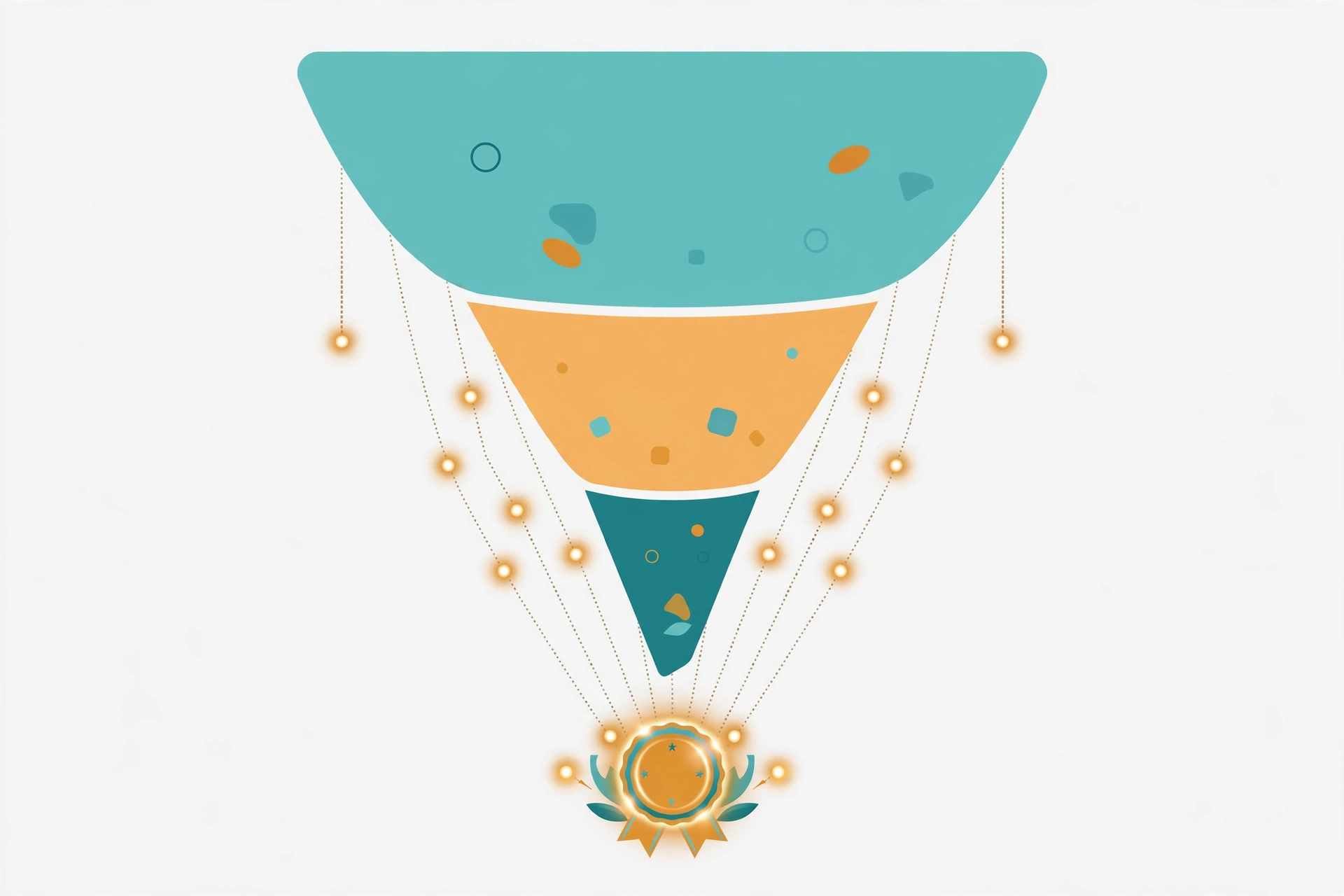
Think of the customer journey as a funnel. At the top (TOFU), a buyer asks broad questions: “what is the best CRM for a small team?” In the middle (MOFU), they compare: “HubSpot vs Pipedrive for a five-person team.” At the bottom (BOFU), they ask for a decision: “which CRM should I buy?”
The question is whether being cited in those early, broad answers makes an AI engine more likely to recommend you at the decision stage. The honest answer, from the best available 2026 data, is: yes, but through mechanisms — not through a funnel the model tracks.
LLMs do not carry a “funnel score” for your brand from one conversation to the next. What transfers is subtler, and it works through three mechanisms:
- Retrieval overlap. When a buyer later asks a decision-stage question, the engine retrieves sources again. Brands with broad, well-distributed coverage are simply more likely to be retrieved a second time. An early mention is evidence of retrievability, and retrievability repeats.
- Entity association. AI systems build an internal picture of which brands belong to which category, with which attributes. Consistent mentions across independent sources strengthen that association — “Brand X is the budget option,” “Brand Y is the enterprise pick.” Attributes and sentiment travel with the entity.
- The comparison set. Middle-of-funnel content teaches the model which brands belong in the same comparison. If your brand is consistently compared against the leaders, it enters the shortlist the model draws from at decision time. Middle-funnel presence transfers far more than top-funnel presence, because it is already framed as a choice.
A 2026 study by SMA Marketing (4,480 API calls across four LLMs and eight verticals, reported April 2026) tested this directly and found that bottom-of-funnel brand convergence is real but heavily model-dependent — varying roughly six-fold between models.
Claude and ChatGPT converged strongly on the same brands; Gemini barely converged at all. Cross-model agreement at the decision stage was strikingly low (Jaccard similarity just 0.15). There is no universal canon of “the best brands” — each engine has its own.
The same study found a “MOFU trough”: middle-of-funnel responses were the longest but mentioned the fewest brands. That matters, because it means comparison content must be exceptionally clear about which brands it covers, or the model will simply skip yours.
There is also a correlation warning. Brands that get cited early tend to be brands that are already well-known, well-reviewed, and well-covered. Early citation may partly reflect strength rather than cause the later recommendation. The practical conclusion survives anyway: broad, credible, third-party coverage is the raw material of both.
What the research actually says works
The GEO paper’s experiments remain the most-cited evidence base. Its headline findings: GEO techniques improved visibility in AI responses by up to 40%, and adding credible citations improved visibility by 115.1% for pages that were not already top-ranked. Statistics and quotations lifted visibility by 30–40%.
Carnegie Mellon’s AutoGEO study (October 2025) pushed further, reporting gains up to 50.99% for content that combined comprehensive coverage, factual accuracy with citations, clear structure (headings and lists), and direct answers.
A 2026 analysis of 22.7 million citations by Wellows (January–June 2026) added a crucial correction to SEO thinking: brand search demand and entity recognition — not backlink volume — were the strongest predictors of being cited. Wikipedia and Reddit held the largest citation share.
Statistics raised citation likelihood by 22% and quotations by 37%. And mention clustering mattered: brands mentioned consistently across many LLMs were up to 2.8 times more likely to win first-position citations.
A Ranktracker analysis of 10,000 generative answers (2025) found that original data earned 3–4 times more inclusion and five times more stable citations, that recently updated pages (within 90 days) beat higher-authority competitors, and that canonical definitions — one clear, quotable definition of a concept — were quoted verbatim.
A University of Toronto study (September 2025, covered by Search Engine Journal) found that AI engines cited third-party authoritative sources 92.1% of the time in consumer electronics, versus 54.1% for Google’s own results. Earned media dominates AI citations.
That single finding explains why third-party coverage is the highest-leverage asset in this new game — and why it connects directly to digital PR services and to the argument we made in Brand Mentions Are Becoming the New Backlinks.
Key numbers at a glance
| Finding | Source | Why it matters |
|---|---|---|
| GEO techniques lifted AI-response visibility up to 40%; credible citations added 115.1% for non-top-ranked pages | GEO paper, ACM KDD 2024 | Citations help lesser-known pages most |
| Structured, cited, comprehensive content gained up to 50.99% | AutoGEO, Carnegie Mellon, Oct 2025 | Structure plus substance together |
| AI cited third-party sources 92.1% of the time vs 54.1% for Google | University of Toronto, Sep 2025 | Earned media dominates AI citations |
| Statistics +22% and quotations +37% citation likelihood; consistent cross-engine mentions up to 2.8x first-position citations | Wellows, 22.7M citations, Jan–Jun 2026 | Numbers and quotes are the most citable atoms |
| Only ~12% overlap between AI-cited sources and Google top 10 (2025); 38% of AI Overview URLs in top 10 by Mar 2026 | Ahrefs | Rankings do not carry over to AI answers |
| Decision-stage cross-model agreement just 0.15; Perplexity missed 89.1% of ChatGPT’s cited sites | SMA Marketing, Apr 2026; Wellows 2026 | No single engine tells the whole story |
Why your Google rankings are not enough anymore
If AI visibility were just SEO with a new name, your rankings would carry over. They largely do not. Ahrefs found in 2025 that only about 12% of AI-cited sources overlapped with Google’s top 10 results.
By March 2026, Ahrefs measured that 38% of AI Overview URLs also ranked in Google’s top 10 — down from about 76% in July 2025. The two systems are diverging, not converging.
An AirOps analysis (548,534 pages, 15,000 prompts) found that 85% of pages retrieved by AI engines never appeared in the final response at all, that 33% of citations came from fan-out sub-questions the user never asked, and that 95% of those sub-questions had zero search volume in keyword tools.
That last point is strategically important: keyword research alone will miss most of the questions AI engines actually answer about your category. You need to test real prompts, not just read volume tables.
SparkToro and Gumshoe tested 2,961 prompts and found the same brands appearing in 55–77% of responses regardless of phrasing. Consistency of the entity — not clever phrasing — is what holds.
How to get cited: the practical playbook
Distilled from the research above, seven practices carry most of the weight:
- Write one canonical definition. For each concept you want to own, publish one clear, quotable definition. AI engines quote definitions verbatim when they are crisp and unambiguous.
- Publish original data. Surveys, benchmarks, price studies, and original analysis are cited 3–4 times more often than rewritten advice. This is the single highest-return content type in the studies.
- Cite credible sources. Pages that cite authoritative third-party sources saw the largest visibility gains in the GEO experiments, especially for pages that were not already top-ranked.
- Use statistics and quotations deliberately. Numbers and direct quotes are the most citable atoms of content: +22% and +37% citation likelihood respectively in the Wellows data.
- Structure for extraction. Clear headings, lists, and direct answers at the top of sections. AutoGEO’s gains came substantially from structure, not just substance.
- Stay fresh. Recency beat authority in the Ranktracker data. Updating a strong page within the last 90 days mattered more than a higher domain rating.
- Build the entity, not just the page. Wikipedia and community sources hold outsized citation share. There are no shortcuts here: Wikipedia has strict notability rules, and a page that does not meet them will be removed. Entity-building is a long game of real coverage, reviews, and references — which is exactly what sustained third-party placements produce.
How to track brand mentions in AI search
Tracking is where most brands are weakest, and search demand confirms it: “how to track brand mentions in ai search” draws 1.3K monthly searches in the US, and “best ways to track brand mentions in ai search” another 880, most of it low-competition. Three methods, used together, cover the ground:
- Manual prompt testing. Run a fixed set of prompts — broad, comparison, and decision-stage — across ChatGPT, Perplexity, and Google AI Mode every month, and record whether your brand is cited, mentioned, or recommended. This is the only method that shows you what customers actually see.
- AI visibility trackers. A growing category of tools monitors brand mentions and citations across engines automatically. Treat their scores as directional: every engine behaves differently, as the SMA data showed, so a single score hides more than it reveals.
- Referral and analytics checks. Watch AI-referred sessions in analytics separately from organic search. AI referral traffic is still small for most sites but growing fast, and it behaves differently from search traffic.
Measure two rates separately, and never blend them: your mention rate in early-stage answers and your recommendation rate in decision-stage answers. A brand can be mentioned everywhere and recommended nowhere — and the gap between those two numbers is the real diagnosis.
The same separation applies to campaign measurement: “how to measure the success of generative engine optimization campaigns” is itself a rising search question (260 monthly searches, very low competition), and the honest answer is that mention rate and recommendation rate are the two metrics that matter, tracked per engine, not as one blended score.
One cross-engine warning from the Wellows data: Perplexity did not cite 89.1% of the sites ChatGPT cited. Optimizing for one engine and assuming the others follow is a mistake. Test each engine you care about.
What this means for digital PR
Here the research points in a commercially useful direction. AI engines cite third-party authoritative sources far more than brand-owned pages. That means the coverage a brand earns on independent publications — reviews, comparisons, expert roundups, contributor articles — is not just reputation or referral traffic anymore. It is the raw material AI answers are built from.
This is why the older SEO question — do backlinks still matter for AI search? — has a nuanced answer. Links still matter for discovery and authority, but in AI search, the mention itself is the unit of value, whether or not it carries a link.
Our earlier piece on off-page SEO beyond backlinks made the same point from the other side: presence across trusted third-party sources is the asset, and links are one form of it.
For a brand planning 2026 visibility work, the implication is concrete: budget that used to go only to ranking pages should also go to being present and quotable in the sources AI engines retrieve — with clear definitions, original data, and quotable claims.
That is placement work, but judged by a new metric: not just “did the link go live,” but “does the AI answer cite us?”
Linkuild does this work directly: as a digital PR and link-building agency, it places clients on independent publications — reviews, comparisons, expert roundups, and contributor articles — so a brand is present, mentioned, and quotable in exactly the sources AI engines retrieve.
The work is judged the same way this article judges it: not only by whether the coverage goes live and stays live, but by whether AI answers cite the brand. See digital PR services for how placements are structured.
The honest limits
No honest article on this topic should end without the caveats:
- There is no universal canon. Cross-model agreement at the decision stage is just 0.15. Winning in ChatGPT does not mean winning in Perplexity or Gemini.
- Correlation is not causation. Cited brands tend to be strong brands. Coverage helps, but it is not a vending machine.
- The MOFU trough is real. Comparison content must name brands explicitly and clearly, or models will answer around you.
- The ground is moving. Overlap between AI citations and Google’s top 10 fell from ~76% to 38% within a year. Any playbook written as permanent will age fast. Re-test quarterly.
- No shortcuts exist. No file format, no schema trick, and no mass-produced content program substitutes for credible, original, third-party-backed presence. Programs built on thin AI content face rejection from ad networks and quality filters alike.
FAQ
What is generative engine optimization (GEO)?
GEO is the practice of optimizing content so generative AI engines retrieve, cite, and rely on it when composing answers — as distinct from classic SEO, which optimizes for ranking in a list of links.
If AI mentions my brand early, will it recommend me at the decision stage?
More likely, but not guaranteed. Early mentions help through retrieval overlap, entity association, and inclusion in the comparison set — middle-funnel comparisons transfer most. But each engine behaves differently, and mention rate and recommendation rate must be measured separately.
How do I track brand mentions in AI search?
Run a fixed prompt set across the major engines monthly, use an AI visibility tracker as a directional aid, and segment AI-referred traffic in analytics. Track mention rate and recommendation rate per engine, not as one blended number.
How long does GEO take to show results?
Published evidence suggests movement within one content-refresh cycle for well-structured, data-rich pages, but entity-level change — becoming a brand the models consistently associate with a category — takes sustained third-party coverage over quarters, not weeks.
This quarter’s checklist
- Pick one concept per priority page and write a canonical, quotable definition for it.
- Add one piece of original data (a stat, a survey, a price study) to each priority page.
- Audit your top pages for credible third-party citations — add them where missing.
- Refresh priority pages (recency beat authority in the data) and restructure with clear headings and direct answers.
- Run a fixed 30-prompt test across ChatGPT, Perplexity, and Google AI Mode; record mention rate and recommendation rate separately.
- Start one sustained third-party coverage effort aimed at the sources AI engines actually cite — and judge it by citations earned, not just links placed.
The era of AI answers rewards the same thing good PR always rewarded — being genuinely present, quotable, and credible in independent sources — but it measures it faster, more visibly, and more ruthlessly than search rankings ever did. Brands that build that presence now, while the field is still forming, will be the ones the answers name later.
Sources (named, by publication): Aggarwal et al., “GEO: Generative Engine Optimization,” ACM KDD 2024; Carnegie Mellon, AutoGEO, October 2025; University of Toronto study, September 2025 (via Search Engine Journal); SMA Marketing study, April 2026; Wellows citation analysis, January–June 2026; Ahrefs AI citation studies, 2025 and March 2026; Pew Research, March 2025; Semrush AI Mode data, September 2025; eMarketer, 2025; Gartner, 2024; SparkToro/Gumshoe prompt study; AirOps retrieval analysis; Ranktracker generative-answer analysis, 2025; keyword data: Semrush Keyword Overview, US database, 25 October 2026.
No competitor link-building platforms are named or endorsed in this article.